

132kV Galvanized Angle Steel Transmission Tower Solutions: Top Options for High-Voltage Projects
2026-09-21
High-voltage transmission projects demand towers that can withstand extreme loads and harsh environments without breaking the budget. Among the available options, 132kV galvanized angle steel towers stand out for their strength-to-weight ratio and long service life. But not every supplier delivers the same level of precision and reliability. In this article, we break down the top solutions, with a close look at how Anbang engineers its towers to meet the toughest grid specifications.
What Makes Galvanized Angle Steel the Go-To for 132kV Structures
Ask a transmission line engineer why nearly every 132kV lattice tower uses galvanized angle steel, and you'll get a one-word answer: reliability. The hot-dip galvanizing bath leaves a zinc-iron alloy layer that is harder than the base steel itself, then caps it with nearly pure zinc. On angle legs sized from L70x70x6 up to L150x150x12, the resulting coating commonly lands between 85 and 120 microns. That thickness shrugs off road salt, coastal chlorides, and acid rain long enough to keep a 132kV structure standing for four decades or more with zero repainting.
The real advantage, though, is how angle steel behaves in a bolted lattice. Angles provide sharp, flat surfaces for punching and drilling before galvanizing, so every connection can be made with standard high-strength bolts and no field welding. This matters on 132kV routes that cross sugarcane fields, river floodplains, or steep ridgelines where a generator and welding rig would be a logistical headache. A kit of pre-galvanized angles can be airlifted or carried by mule in bundles, then assembled with hand tools by a small crew.
There is also a quiet cost logic at play. Galvanized angle steel is one of the few materials whose first cost and whole-life cost are both predictable. Scrap value stays high, and because the section is open, inspectors can visually check the coating without ultrasound or paint-thickness gauges. For utilities that own hundreds of 132kV structures, that simplicity translates into fewer outage windows and lower maintenance budgets over the asset's life.
Suspension, Tension, and Dead-End Towers for Different Line Sections
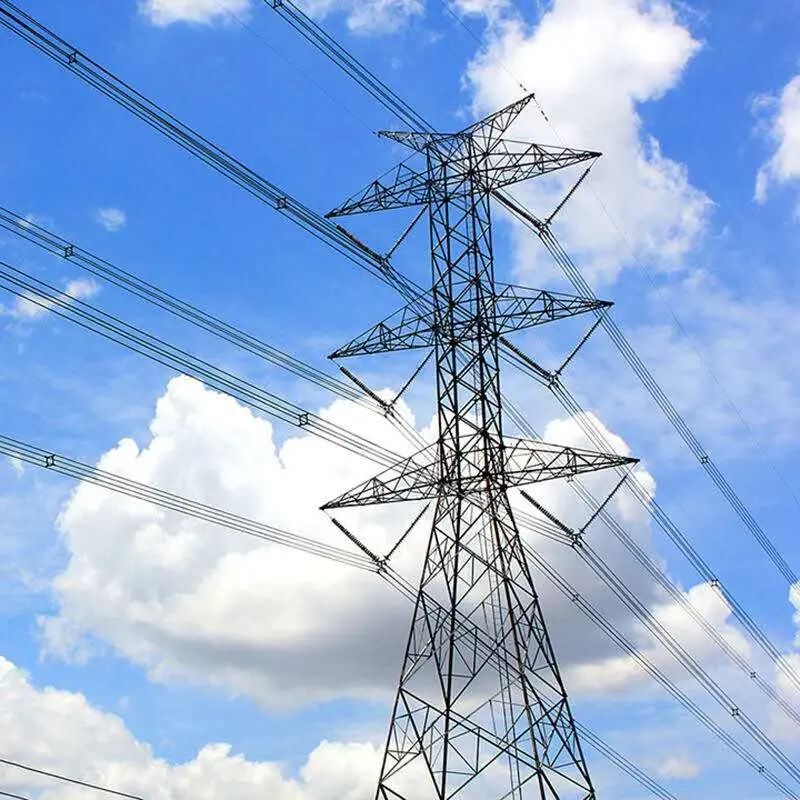
Suspension towers carry the conductors along straight or gently curving sections of a line. Their primary job is to support vertical weight and small longitudinal imbalances, so they tend to be lighter and more economical than other tower types. On long, uninterrupted stretches, suspension towers dominate the line profile and account for the majority of structures.
Tension towers, often called angle or strain towers, are placed where the line changes direction or where a long tangent section must be broken into manageable tension segments. These towers are designed to resist the full conductor tension on both sides, preventing a cascading failure if a conductor breaks. Dead-end towers are a specialized form of tension tower used at the very beginning or end of a line, or at major substation interfaces, where the conductors are terminated and their tension is transferred to station structures.
Choosing between these tower types for a given line section depends on turning angles, terrain, ice and wind loads, and the need to isolate sections for maintenance. A typical transmission route alternates between long runs of suspension towers and strategically placed tension or dead-end structures to balance cost, reliability, and ease of construction.
How Galvanizing Thickness Impacts Decades of Service Life
The thickness of a galvanized coating is the single most reliable predictor of how long a steel structure will resist corrosion. Every micron of zinc acts as a sacrificial layer, corroding slowly and predictably over time before the base steel is ever threatened. In mild atmospheric conditions, a standard hot-dip galvanized coating of 85 microns can easily provide half a century of maintenance-free protection. Increase that thickness to 140 microns—common for heavier structural sections—and the service life stretches well beyond 75 years, even in more aggressive industrial or coastal environments.
Thicker zinc layers do more than just last longer; they fundamentally change how corrosion spreads. When a scratch or impact exposes the underlying steel, the surrounding zinc sacrifices itself to protect that exposed area, a process known as cathodic protection. A thicker coating provides a larger reservoir of zinc, which means a localized breach can be sealed by corrosion products for decades before the steel itself begins to oxidize. This self-healing behavior is why bridge girders, transmission towers, and marine pilings with 100-plus micron coatings routinely outlive their design life without a single repaint.
However, galvanizing thickness is not a simple case of “more is always better.” Excessively thick coatings can become brittle, especially on sharp edges or during thermal cycling, leading to flaking in high-stress applications. The real skill lies in matching coating thickness to both the environment and the geometry of the part. A well-specified galvanized layer—neither too thin for the exposure nor so thick that it compromises adhesion—delivers decades of predictable, low-cost service life. That balance is what separates a 30-year coating from one still standing strong at 80.
Trimming Weight While Meeting Wind and Ice Load Requirements
Reducing structural mass without compromising wind and ice resilience often starts with rethinking cross-sections and load paths. Rather than simply thinning members, engineers shift material to where bending moments and buckling forces actually concentrate. For lattice towers and masts, this can mean using tapered tubular sections or cold-formed angles with optimized thickness distribution, trimming kilograms while keeping the same projected area that wind and ice act upon.
Ice accumulation adds both static weight and surface roughness, which can amplify wind drag. One practical approach is to specify high-strength, low-alloy steels or aluminum alloys that retain toughness at low temperatures, allowing thinner walls without sacrificing dent resistance from hail or impact. In joints and connections, replacing heavy gusset plates with cast or forged nodes cuts dead load and reduces the number of bolts, all while maintaining the stiffness needed to prevent fatigue under cyclic wind gusts.
On the software side, iterative finite element analysis lets designers map exactly where ice loads push a structure toward its limit, then remove material only from low-stress zones. Some teams also adopt aerodynamic profiling for non-circular members to reduce wind pressure coefficients, which lowers the required strength demand. The result is a leaner assembly that still clears code checks for combined wind and ice scenarios without overbuilding.
Faster Erection Through Modular Angle Steel Details
Speed on site rarely comes from working harder—it comes from removing decisions. Modular angle steel details do exactly that. Instead of cutting, coping, and drilling at the column base or beam connection after steel lands, crews arrive to pre-punched splice plates, matching hole patterns, and angle cleats that only fit one way. The result is fewer layout checks and a shorter gap between crane picks.
A well-detailed modular angle connection also reduces the small cumulative delays that kill a schedule. When angles are standardized for bolt diameter, edge distance, and gauge lines, ironworkers don't have to sort through mixed hardware or field-modify clips. Temporary alignment tabs or slotted holes on the angle leg let the piece hang in place while the next member is released from the crane, so the hook isn't waiting on a fitter.
The payoff shows up most clearly on repeat bays and multi-level framing. Once the first connection is set and checked, every similar joint follows the same sequence. That repetition, built into the angle details rather than left to field judgment, can cut erection hours enough to pull a day or more out of a typical steel package.
Adapting Tower Geometry to Steep Slopes and Sharp Line Angles
Terrain rarely cooperates with standard tower footprints. On steep slopes, a four-legged tower planted on a uniform base would require massive earthworks or leave one leg hanging. Instead, designers adjust the geometry by extending individual legs—sometimes several meters—to match the slope profile. The tower body stays plumb, but the leg lengths differ, creating a stepped foundation that follows the ground rather than fighting it. This keeps excavation minimal and preserves the hillside's natural stability.
Sharp line angles introduce a different set of forces. A transmission line turning sharply pulls the tower sideways, so the crossarm and body geometry must resist torsion that a straight-line tower never experiences. Here, the tower's plan shape may shift from square to rectangular, with a wider stance perpendicular to the angle bisector. Additional bracing, heavier steel on the inner corner, and asymmetric crossarm lengths help redirect the conductor tension without overloading any single member.
Combining both conditions—steep grade and a tight corner—forces a more bespoke solution. Leg extensions are calculated independently for each of the four corners, while the body above may be rotated relative to the foundation to align with the bisector of the line angle. The result is a tower that looks slightly twisted from a distance but behaves predictably under load. Field surveys, not catalog drawings, dictate final dimensions, and every tower on a difficult site tends to be unique.
FAQ
Hot-dip galvanized angle steel offers a balanced mix of strength, corrosion resistance, and ease of assembly. The L-shaped sections bolt together cleanly in the field, and the zinc coating adds decades of low-maintenance service even in industrial or coastal air.
The zinc layer acts as a sacrificial barrier. If the coating gets scratched, the surrounding zinc corrodes first and protects the exposed steel. This self-healing behavior is especially useful for towers near saltwater, chemical plants, or areas with frequent fog and rain.
Most suspension towers fall between 25 and 45 meters tall, depending on ground clearance and conductor sag. Weight varies with design and wind zone, but a standard lattice body usually runs from 6 to 15 metric tons, with heavier angles used for dead-end and angle towers.
Common options include single-circuit and double-circuit lattice towers, with either horizontal or triangular conductor arrangements. For hilly terrain, compact delta configurations reduce right-of-way needs, while flat areas often use wider horizontal crossarms for easier maintenance.
Steep slopes may call for unequal leg extensions or shorter body sections, while high-wind regions require stronger bracing patterns and thicker main leg angles. Icing zones need wider phase spacing and heavier members to handle extra vertical load without excessive deflection.
Beyond upfront material cost, look at fabrication tolerances, bolt compatibility, delivery lead times, and ease of field assembly. A tower that erects faster with fewer crane lifts can offset a slightly higher steel price, especially in remote or access-limited sites.
Yes, most utilities follow IEC 60826 or national equivalents, specifying wind, ice, broken-wire, and construction loads. The tower must also handle everyday tension differences, conductor vibration, and seismic forces if the region is seismically active.
Galvanized towers typically need little more than visual inspections for the first 15 to 25 years. Painted towers often require spot touch-ups or full repainting much sooner. When galvanized coating eventually thins in aggressive environments, cold zinc sprays or zinc-rich paints can extend service life without full replacement.
Conclusion
For 132kV high-voltage lines, hot-dip galvanized angle steel remains the most reliable choice because it balances structural strength with long-term corrosion protection. The zinc coating acts as a sacrificial barrier, and its thickness directly determines how many decades the tower can stand in aggressive environments without significant rust. Designers use different tower configurations—suspension types for straight runs, tension towers for angle points, and dead-end structures to handle full conductor pull at line terminations. Each type relies on the same angle steel lattice form but varies in bracing patterns and member sizes to match mechanical loads. Galvanizing thickness becomes a critical specification: a minimum of 85 microns is common for moderate climates, while coastal or industrial zones may require 100 microns or more to prevent premature weakening. This focus on coating durability avoids costly maintenance cycles and keeps the line in service.
Beyond corrosion, modern angle steel towers are engineered to trim weight without compromising safety under severe wind and ice loads. By using higher-strength steel grades and optimizing leg slopes, cross-arm lengths, and redundant members, engineers reduce foundation loads and material costs. Modular angle steel details with pre-punched bolt holes and numbered sections speed up erection, cutting on-site labor and crane time. For difficult terrain, tower geometry adapts through unequal leg extensions, stub angles, and body bridges that allow stable placement on steep slopes or sharp line angles without custom foundations. These practical solutions make 132kV galvanized angle steel towers a versatile, long-lasting option for high-voltage projects in varied landscapes.
Contact Us
Contact Person: antor khan
Email: [email protected]
Tel/WhatsApp: 8613863903569
Website: https://www.qdabtower.com/