

Batch Off Cooler Company Guide to Reliable Rubber Cooling Solutions
2026-10-25
If you've ever dealt with a batch of rubber that comes off the mill too hot, too tacky, or inconsistently cooled, you already know why the batch off cooler deserves more attention. A reliable cooling line doesn't just prevent downtime—it protects your compound's consistency and your downstream process. In this guide, we're looking at what makes a rubber cooling solution genuinely dependable, and how SFC designs batch off coolers for real-world production rather than ideal conditions.
How Batch Off Coolers Tame Hot Rubber Without Losing Throughput
Hot rubber leaving an internal mixer carries enough heat to stay tacky and start scorching if left in a pile. That’s where a batch-off cooler steps in. Instead of relying on a single water bath, it combines a quick anti-tack dip with a long cooling conveyor that pulls air across the strip or slab. The result is a surface that sets fast, so the batch can be stacked or fed downstream without sticking, while the core temperature drops enough to prevent premature cure.
The throughput part is what separates a well-designed cooler from a bottleneck. Modern units run a continuous loop of batch-off bars or belts, allowing the next mixer drop to enter while the previous batch is still cooling. Variable-speed fans and adjustable dip tank levels let operators match cooling rate to compound viscosity and ambient conditions. Some coolers also use multi-tier conveyors, which pack more cooling length into the same floor space, so you’re not waiting for one huge batch to finish before starting another.
Small design choices make a big difference. Quick-change dip tanks keep the anti-tack solution clean without shutting down the line. Sensors track strip temperature at multiple points and automatically adjust air volume, so the cooler doesn’t over-dry light-colored compounds or under-cool high-viscosity ones. The goal isn’t just cold rubber—it’s rubber at the right temperature for the next operation, whether that’s milling, extruding, or building a tire. When the cooling step disappears into the line’s rhythm, throughput stays where it should be.
Matching Cooler Components to Your Rubber Compound’s Temperament
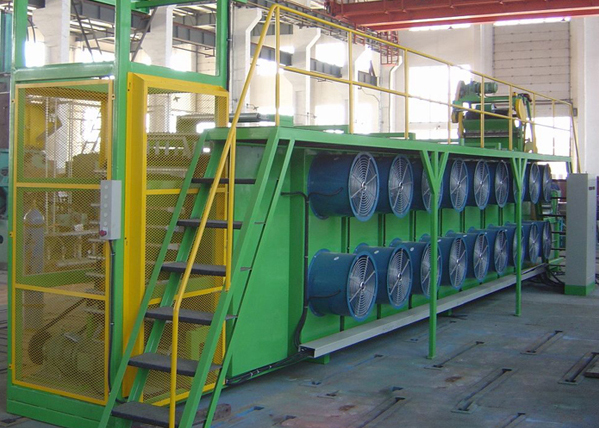
Every rubber compound leaves the mixer with its own set of quirks. Some stocks stay tacky enough to grab onto anything they touch, while others stiffen within seconds of hitting room air. A batch-off cooler can't treat them all the same. The dip tank, coating applicator, and cooling fans need to be dialed in to how that particular batch behaves. A high-natural-rubber formulation with aggressive surface tack will usually demand a heavier anti-tack slurry and gentle agitation so the sheet doesn't tear. But a fast-curing EPDM that carries a lot of heat into the cooler may need extra airflow and a longer dwell before it's safe to stack.
The temperament shows up most clearly at the transition points—entry into the dip tank, the first bend around the cooling drums, and the final festoon drop. A compound that releases easily from metal can get away with a simple dip and drip; one that sticks to every roller forces you to adjust coating chemistry or add release aids at each contact point. Temperature profile matters too. A high-viscosity stock that cools unevenly may develop surface cracking or trap heat in the middle of the slab, so fan speed and belt speed have to be matched rather than set once and forgotten.
Instead of treating cooler settings as fixed parameters, run a few small batches and watch how the compound responds. If the slab ripples or sags between supports, reduce belt load or increase cooling time. If the anti-tack builds up unevenly, your dip tank circulation may need a different baffle arrangement. Small changes in component behavior—like adjusting the air knife angle or changing the dip tank weir height—can settle a fussy compound without reformulating the rubber itself.
Sizing the Line for Real Batch Weights, Not Catalogue Numbers
Most OEM machine lines are spec'd around nominal catalogue throughputs that rarely hold up once you switch to actual production batches. A machine rated for 5,000 units per hour might only sustain 3,200 when the real batch weight drifts 18% above the datasheet value. If you size conveyors, buffers, and reject stations off the brochure number, every downstream station inherits that same fiction.
The practical fix is to pull the last thirty days of batch weight data from your historian, not the ERP's planned-order table. Look at the 95th percentile weight, not the average. Then add your manual dump cycles, line stops for label changes, and the occasional overweight slug that trips a downstream checkweigher. That gives you a line rate based on what the equipment will actually see, not what the sales engineer promised.
When you present the sized line to operations, skip the generic safety factor. Show them the histogram of real batch weights and the specific bottleneck stations that shift once you account for that variance. They'll argue about the sensor delay and the reject bin capacity, but at least the argument starts from real production data instead of a glossy cut sheet.
Anti-Tack Systems That Keep Sheets Separate Without Waste
Traditional anti-tack systems often rely on powder sprays—usually starch or mineral-based—to create a physical barrier between freshly printed sheets. While effective at preventing ink transfer, these powders drift into the air, coat machine surfaces, and generate significant cleanup waste. The shift toward powder-free separation tackles the root problem: keeping sheets apart without adding anything that later needs to be removed or discarded.
One practical approach uses precisely angled air jets that lift the trailing edge of each sheet just enough to break surface contact without disturbing the wet ink film. Combined with a controlled vacuum hold-down on the delivery stack, this keeps individual sheets separated through the critical drying window. Because no powder is introduced, there is nothing to vacuum off the floor, wash out of grippers, or filter from the exhaust—eliminating a whole category of consumable waste.
Another emerging design pairs a micro-textured roller with an ionizing bar to neutralize static cling, which is often the real culprit behind sheets sticking together. The roller imparts a faint, temporary separation pattern on the substrate, while the ionizer prevents sheets from reattaching due to electrostatic charge. Users can dial in the exact amount of separation force for different paper weights and coatings, avoiding the one-size-fits-all overuse common with powder systems. The result is cleaner air, less downtime for maintenance, and zero spent powder entering the waste stream.
Floor Layouts That Save Space Without Choking Airflow
Open, low-slung furniture keeps sightlines clear while allowing air to move across the room without hitting bulky blockers.
Instead of pushing a sofa against the only return vent, use a slim console or a bench with legs—pieces that don't sit flush to the floor and still let the HVAC pull air back in.
Vertical shelving along interior walls can tuck storage up high, leaving floor registers and doorways unobstructed so the space feels bigger and breathes even in tight layouts.
Reading the Warning Signs of Inconsistent Cooling Early
One of the first signs that a cooling system is struggling to maintain steady performance is a subtle shift in temperature consistency across different areas. You might notice that one corner of a room stays noticeably warmer, or that a particular piece of equipment runs hotter at the same duty cycle than it did a few weeks ago. These small discrepancies rarely appear overnight; they build gradually, often dismissed as minor quirks until they become costly failures. Paying attention to how quickly temperatures recover after a door opens or a load increases can also reveal trouble. A system that used to stabilize in minutes but now drifts for half an hour is telling you something about its internal health.
Another warning sign hides in the sound and feel of the system itself. Compressors that cycle on and off more frequently than normal, fans that run at full speed without the usual ramp-down period, or pipes that alternate between warm and cold to the touch all point to uneven heat removal. The underlying causes can range from a partially blocked filter to a refrigerant charge that is no longer optimal, but the pattern is the same: the system is working harder to achieve less. When multiple indicators appear together—such as longer runtimes paired with wider temperature swings—it is wise to treat the situation as a developing fault rather than a temporary fluctuation.
Regular observation of baseline readings makes these early symptoms easier to spot. Instead of reacting only when a sensor alarm triggers, tracking small deviations in temperature, pressure, or energy use over time builds a picture of normal behavior. A drift of even a few degrees in the average temperature difference across an evaporator or condenser can signal that something is beginning to clog or leak. The key is to view inconsistency as information, not annoyance. By catching these clues before they escalate, maintenance can often be scheduled at a convenient time, replacing a minor component instead of waiting for a complete breakdown that halts production or compromises sensitive environments.
FAQ
It receives hot rubber sheets or strips from a mill or extruder, dips them in an anti-tack solution, and carries them through a cooling tunnel where forced air brings the temperature down to a safe level before stacking or palletizing.
The key is a controlled dwell time with even airflow across the full width of the batch. The anti-tack dip creates a thin barrier on the surface, and gradual cooling prevents the rubber from collapsing under its own weight while still warm.
Look for modular construction, adjustable dip tank depth, variable speed drives, and a fan layout that avoids dead spots. The cooling length should match your line speed and compound heat load, not just a generic throughput number.
Weekly checks of belt tracking and tension, monthly cleaning of dip tank nozzles and drain filters, and quarterly inspection of fan bearings and motor couplings. Keeping the dip solution free of debris prevents most sticking problems.
Yes, but the settings must be tuned. Natural rubber tends to retain heat longer, so you may need a lower line speed or higher airflow. Synthetic compounds often benefit from a lighter anti-tack coating to avoid surface residue.
Rubber arriving at the stacking station above 40°C, uneven cooling across the sheet width, excessive carry-over of anti-tack liquid, or belt drift that requires frequent manual correction. Any of these points to airflow or tracking issues.
Uniform airflow prevents hotspots where the rubber remains warm in the center or along one edge. Variable fans or dampers let you balance air across the belt, which is critical if you run multiple compound widths on the same line.
A basic system just moves rubber through cold air. A quality batch off cooler integrates dip station control, wash-down access, precise belt speed matching with the mill, and temperature monitoring at discharge so you can verify every batch is below the sticking threshold.
Conclusion
Getting rubber out of a mill at the right temperature usually means fighting two battles at once: heat history and line speed. A well-designed batch off cooler doesn't just blast air at a hot slab, it reads the compound. High-green-strength stocks can take a steeper drop section and faster bar speeds, while softer, tackier compounds need gentler handling and longer dwell. The difference shows up in the first ten metres. If you size the cooler for actual batch weights rather than catalogue numbers, you stop paying for unused cooling length or, worse, stacking sheets before they've shed enough heat. Anti-tack is the other half of that equation. Instead of flooding the dip tank and hoping for the best, matched nozzles and adjustable immersion let you use just enough coating to keep sheets from marrying in the stack without building a dusty, reject-prone surface.
Floor layout quietly decides whether a cooler runs clean or becomes a bottleneck. The best lines keep return air paths short and don't trap hot exhaust under mezzanines or near intake filters. That means leaving enough clearance for fans to pull air across the full sheet width, not just the edges. On the maintenance side, early warnings matter more than scheduled downtime. A fan that starts cycling, a mist extractor that clogs every shift, or a discharge conveyor that runs warm at the same spot each batch all point to airflow imbalance or load drift. Catching those signs before they become temperature spec failures is what separates a reliable cooling line from one that constantly needs nursing. None of this is exotic, but in a working rubber plant, the details are the difference between a cooler that handles the week's production and one that sets the pace for everyone else.
Contact Us
Contact Person: Chen Zhengwei
Email: [email protected]
Tel/WhatsApp: +86-13963975727
Website: https://www.sfcrubbermachine.com