

Calcium Chloride 77% Prills Exporter Delivering Consistent Quality Worldwide
2026-10-30
When operations depend on calcium chloride 77% prills, inconsistency isn't an option. That's the principle behind Shouguang Golden Chemical, an exporter trusted worldwide for dependable, high-purity supply. Here's why that trust is earned—one shipment at a time.
The 77% Prills That Don't Clump in the Container
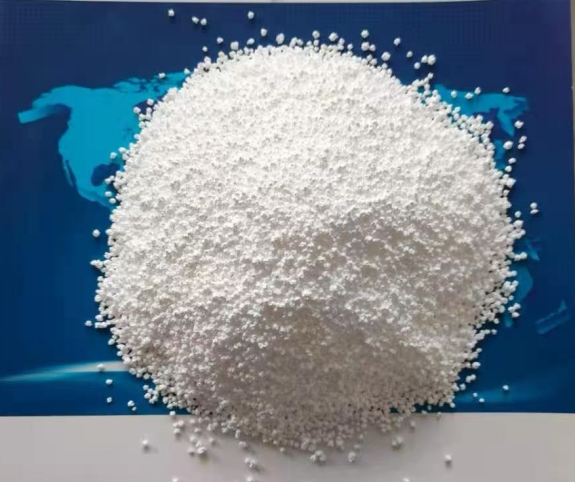
These 77% prills hold their shape and stay loose even after weeks inside a sealed container. The low-moisture surface treatment keeps individual granules from sticking together, so you can pour out exactly what you need without shaking or chipping away at a solid block.
Long storage times are usually where most granular products fail, but this formulation is different. The narrow particle size distribution means there’s less fine dust to act as a binding agent between larger prills. As a result, the material flows freely from the first scoop to the last, and you won’t find hard lumps hiding at the bottom of the bag or bucket.
That consistency also matters when you're measuring by volume or using a spreader. Clumped granules throw off calibration and lead to uneven application, but with a free-flowing 77% prill, every pass stays predictable. The container opens clean, pours smooth, and closes without leaving a crust behind.
Quality Checks That Happen Before You Even Ask
Most people assume quality control starts when a complaint lands in the inbox. In practice, the work is already done long before that. Every batch gets pulled at random, not just the ones flagged by automation. A torque wrench gets recalibrated at noon, not when it drifts. Threads on a machined fitting are measured against a reference standard that lives in a locked drawer — the same one used three shifts ago. If something feels off, even slightly, the line stops. Nobody waits for a customer to notice.
There is also a quieter layer of checks that never shows up in a report. A second set of eyes reads the assembly notes for contradictions. Packaging gets drop-tested with the same box style that actually ships, not a prettier prototype. And before anything leaves the floor, someone physically wipes down the mating surfaces and checks for burrs with a thumbnail. That kind of inspection isn't written into a contract; it's just the standard people hold themselves to.
The result is that most “requests” for rework never need to happen. By the time a buyer asks about tolerance, the answer is already documented, dated, and attached to the lot number. The goal isn't to pass an audit. It's to make the audit boring.
Why Our Export Docs Are as Clean as Our Product
Every shipment leaves our facility with paperwork that gets the same scrutiny as the goods inside the crate. We’ve seen too many delays caused by sloppy documentation—wrong codes, missing declarations, blurred stamps—so our team treats each form as part of the product itself.
A clean bill of lading, a precise packing list, and a certificate of origin that actually matches the invoice aren’t down to luck. We run a triple-check before anything goes to the port, and we keep template versions updated whenever trade rules shift. That way the documents speak the same quality language as the hardware they accompany.
The result is fewer hold-ups at customs and fewer calls asking for corrections. Buyers can hand our paperwork straight to their brokers without second-guessing. When the product arrives spotless and the documents arrive readable, it’s not a coincidence—it’s the same standard applied twice.
De-icing, Dust Control, and the Grade That Delivers Both
Winter road maintenance and summer dust suppression rarely share the same product spec, but a select grade of hygroscopic salt bridges that gap. The right formulation pulls moisture from the air to keep surfaces damp enough for dust control, yet still depresses the freezing point effectively when temperatures drop. It’s not about stocking two separate materials—it’s about knowing which grade handles both jobs without compromise.
On the de-icing side, this grade works fast at the pavement interface, breaking the bond between ice and road before refreeze cycles can take hold. The same granular profile that spreads evenly on icy patches also resists clumping in storage, so transition-season stockpiles stay workable. For dust control, the moisture-attracting properties bind fine particles on unpaved roads and industrial lots, cutting airborne dust without turning the surface into a muddy mess.
Operators who switch to this dual-purpose grade often cut inventory complexity and reduce reorder frequency. Instead of juggling separate de-icing and dust-control products, one bulk order covers both seasonal needs. Field results show fewer complaints about dust plumes in dry months and quicker response times when ice events hit—proof that the right grade isn’t just a compromise, but a practical upgrade for year-round surface management.
When Your Supplier Actually Answers on a Different Time Zone
You ping your supplier at 10 a.m. your time, expecting a quick reply. But your message lands at 2 a.m. where they are. The response doesn't come until your evening, and suddenly your whole workflow shifts. This isn't a rare hiccup—it's the constant rhythm when your supplier actually answers on a different time zone.
The trick isn't forcing them to match your hours. It's learning to use the offset. Send detailed questions before you log off, so their morning starts with everything they need. Keep a shared document for updates instead of relying on live chat. And when you really need a real-time conversation, schedule it during the brief overlap—even if that means one of you is sipping coffee at an odd hour.
Most importantly, adjust your expectations. If every quote or revision takes an extra day because of the time difference, build that into your timeline from the start. Once you stop treating the lag as an obstacle and start seeing it as a predictable pattern, you can actually turn those quiet hours into your own deep-work window while waiting for their reply.
The Reason Repeat Orders Keep Coming From Six Continents
It starts with consistency. A buyer in São Paulo knows the same alloy batch meets the spec sheet every time, and a partner in Rotterdam never has to re-measure tolerances on arrival. That kind of dependability removes the hidden cost of uncertainty, so repeat orders become a reflex rather than a decision.
Logistics also play a quieter role than most people admit. We buffer production schedules around port congestion in Asia, keep regional warehousing for common SKUs in Frankfurt and Chicago, and document every lot so customs clearance rarely adds more than a day. When freight arrives on time and intact, reordering feels low-risk.
Then there is the human side. Account managers stay with the same clients for years, learn their seasonal demand shifts, and often flag a material shortage before the customer notices it. That proactive attention, combined with fair pricing on repeat volumes, is why a first order from Sydney or Nairobi often turns into a decade-long buying pattern across six continents.
FAQ
The 77% concentration gives you strong moisture absorption without the handling issues of flake or powder forms. The prill shape stays free-flowing in storage and spreads evenly, which reduces waste on job sites.
We test every production lot for purity, particle size, and moisture content before it leaves the warehouse. That way customers receive the same performance whether they order in January or September.
Most of our shipments go to construction, oil and gas, and de-icing operations. We also work with food processing facilities that need calcium chloride for brine systems and concrete producers who rely on it as an accelerator.
Yes, we ship both bulk and palletized loads in 20-foot and 40-foot containers. Our export team coordinates documentation and customs clearance so the product arrives without delays.
We offer 25 kg woven bags, 50 lb paper bags, and 1,000 kg bulk bags. All packaging is moisture-resistant and labeled with the UN number and handling instructions required by most ports.
Keep them in a dry, covered area away from direct sunlight. If the original packaging stays sealed, the product typically remains free-flowing for up to 12 months.
Prills produce less dust during handling and dissolve at a predictable rate. They also resist caking better than flake, which matters when the material sits in a silo or spreader for weeks.
Conclusion
Anyone who has dealt with bulk minerals knows the disappointment of opening a container to find a fused, rock-hard mass. That scenario is exactly what this 77% calcium chloride prill specification is engineered to avoid. The prills hold their shape through long ocean transits and temperature swings, arriving as free-flowing as the day they were bagged. Before a single pallet is wrapped, each production lot passes through a series of checks that cover moisture content, particle size distribution, and purity. These aren't last-minute spot tests; they're built into the line schedule so that questionable material never reaches the loading dock. The result is a grade that performs equally well for winter road de-icing and for controlling dust on unpaved haul routes. Municipal crews and mining operations don't have to choose between speed of melt and residual effectiveness, because the 77% concentration balances both.
Behind that physical consistency sits an export team that treats paperwork as part of the product. Certificates of analysis, packing lists, and bills of lading match the actual shipment without the usual back-and-forth corrections. A buyer in Rotterdam or Santiago doesn't need to send three emails chasing a document; it's already in hand before the vessel docks. Communication works across time zones because someone on the supplier side keeps a deliberate overlap with the customer's working hours. That might sound like a small thing until a customs agent flags a pallet label at 9 p.m. in the buyer's country. The real proof, though, is the repeat business. Orders come back from six continents not because of a flashy brochure, but because the prills behave the same way every time and the people behind them answer when it matters.
Contact Us
Contact Person: Tom Cui
Email: [email protected]
Tel/WhatsApp: +8618663670626
Website: https://www.jinjigoldenchem.com