

China Hook Type Shot Blasting Machine Supplier Delivers Efficient Cleaning Solutions
2026-10-19
Getting consistent, high-speed surface cleaning on complex metal parts often means choosing between productivity and machine longevity. That tension disappears when the right hook type shot blasting system is paired with a supplier that understands real production lines. At PuHua, efficient cleaning solutions aren't a brochure claim—they're engineered into every hook type machine we ship from China to factories worldwide. This post looks at how our designs reduce cycle times, cut abrasive waste, and keep your workflow moving.
How Hook Type Machines Cut Cleaning Time in Half
Most cleaning slowdowns come from repositioning parts, not from the wash cycle itself. Hook type machines sidestep that by keeping workpieces suspended and rotated throughout the spray or immersion stage. Every exposed face gets hit in a single pass, so there’s no pause to flip, re-fixture, or run a second cycle for the blind side.
Loading is just as quick. Operators hang parts on hooks, close the door, and start the cycle—no trays, baskets, or custom fixtures to assemble. Because the hook rotates continuously, the cleaning media reaches under shoulders, inside bores, and around bosses without manual adjustment. That cuts the typical load-unload-reload sequence down to one motion.
The time savings show up most in mixed-batch work. A shop that used to clean a rack of castings in two or three passes can often finish it in one, since the part never sits still long enough to trap debris. Fewer repeat cycles, less handling, and no repositioning means the total cleaning time drops by half on many jobs.
Inside the Design That Handles Heavy Loads Without Jams
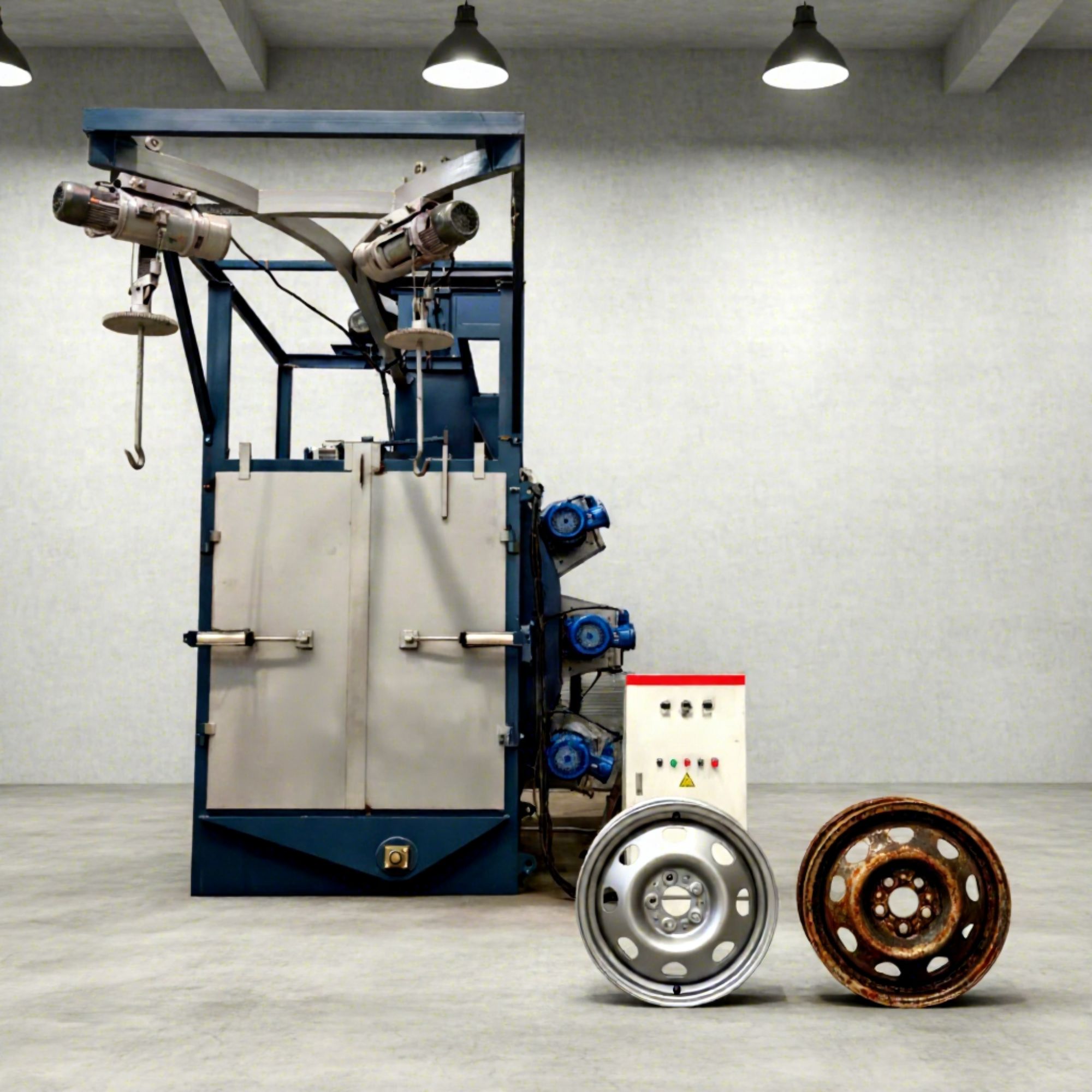
The core trick lies in a tapered feed chamber that widens just enough to let dense materials settle without locking together. Most jams happen when pressure builds unevenly, forcing chunks to interlock at a narrow throat. Here, the walls angle outward by three degrees past the critical point, so the load shifts sideways instead of stacking straight down. Even at full capacity, the material behaves more like a slow fluid than a column of stubborn blocks.
A set of counter-rotating helical vanes does the heavy lifting, but their pitch changes halfway along the shaft. The first section grabs and breaks up clumps, while the second slows the feed rate just before the discharge port. That mismatch creates a gentle backpressure that actually prevents compaction, rather than causing it. Paired with hardened steel liners that flex a few millimeters under load, the whole assembly sheds stress instead of letting it accumulate at a single point.
What really sets this apart is the lack of any straight drop zone. Every path the material takes includes at least one lateral slide or rotating surface, so gravity never gets a chance to slam the load into a dead corner. Combined with an open-sided frame that lets debris fall away naturally, the design stays clean even after hours of continuous feeding. No extra sensors, no software overrides—just geometry doing what geometry does best.
From Castings to Weldments One Machine for Every Part
Swapping between a heavy cast housing and a thin-walled weldment usually means juggling separate setups, tooling libraries, and even different machines. That split is disappearing. Modern multitasking platforms now handle roughing, semi-finishing, and drilling across both material conditions without forcing you to re-fixture or babysit thermal drift.
The real advantage shows up in mixed-batch work. A machine that can push through interrupted cuts on cast iron in the morning and then switch to long, chatter-prone passes on a welded steel frame by afternoon keeps floor space down and lets one operator manage far more throughput. It is less about raw spindle power and more about tuned damping, toolpath control, and quick-change workholding that adapt to the part instead of the other way around.
For shops tired of dedicating cells to a single material or geometry, this collapses the old boundaries. You stop thinking in terms of a casting line versus a weldment line and start scheduling by what actually matters: due date, tolerance, and available spindle hours.
Fewer Stoppages More Throughput in Maintenance
Maintenance departments often chase their own tail: a pump fails, a line stops, and the response is to add another inspection to the schedule. The assumption is that more maintenance activity equals fewer failures. In practice, that approach pads the calendar with checks that rarely prevent anything, while still leaving you exposed to the random breakdowns that actually kill throughput. Cutting stoppages isn’t about doing more maintenance—it’s about doing the right maintenance at the right time, and having the nerve to stop doing the rest.
Start by looking at your last twenty unplanned stops. Not the generic categories like “electrical” or “mechanical,” but the actual trigger: a worn coupling that nobody monitored, a filter that clogged because the pressure differential was never trended, a bearing that ran hot for three weeks before seizing. When you dig into those root causes, a pattern emerges—most failures give you a warning, but your current schedule ignores it. Switching to condition-based triggers for just those failure modes removes a chunk of preventive work while catching problems earlier. The result is fewer line interruptions, and the ones you do have are shorter because you already know what to fix.
The other half of the equation is speed of response. A stoppage that costs thirty minutes of production isn’t just a maintenance problem—it’s a workflow problem. If the technician has to walk to the crib, wait for a permit, search for a drawing, and then find the right tool, that’s twenty minutes of dead time before the wrench even turns. Put spares and tools at the point of use, pre-authorize low-risk tasks, and give operators basic troubleshooting authority. Those changes don’t show up in a CMMS report, but they show up on the throughput chart. Fewer stoppages, faster restarts, and more product out the door—that’s the whole point of maintenance, after all.
Choosing a Supplier That Understands Your Production Flow
The real test of a supplier shows up when your line is mid-shift and a material doesn't fit the schedule. A partner who has walked your floor understands that a fifteen-minute delay at receiving can cascade into a two-hour gap in final assembly. Ask them how they'd handle a sudden change in batching or a skipped QC hold, and listen for specifics rather than promises.
You don't need a vendor who memorizes your part numbers; you need one who learns the rhythm of your operation. Does the supplier know which SKUs move faster on your second shift? Can they stage deliveries to avoid congesting the dock right before a line changeover? Those small adjustments matter more than a perfect scorecard, because they keep your flow continuous instead of forcing you to work around someone else's schedule.
The Hidden Cost Savings of Efficient Abrasive Delivery
Many operations fixate on the sticker price of abrasive media, yet a far larger chunk of spending hides in how that media travels from hopper to nozzle. A poorly tuned delivery line leaks material at every bend, overworks the compressor, and forces workers to stop for constant refills or clog clearing. By contrast, a delivery circuit matched to the abrasive’s density and particle size keeps the flow steady and contained. The result is less waste per square foot of surface prep, which shows up not as a line item but as a smaller reorder quantity month after month.
Energy draw is another quiet budget drain. When abrasive moves through undersized hoses or excessive lengths, the system compensates with higher air pressure or pump speed. This burns electricity or fuel far beyond what the job requires. Efficient delivery design—smooth bore hoses, properly sized nozzles, and minimal bends—drops the operating pressure without sacrificing impact velocity. Over a year of continuous blasting, the kilowatt or fuel savings can rival the cost of a new blast pot, yet it rarely appears on a project invoice.
Downtime and maintenance form the third hidden layer. Every clogged line or worn elbow means a crew standing idle while someone digs out compacted grit or swaps fittings. Those minutes add up to full shifts lost across a quarter. Efficient delivery reduces abrasive settling and turbulence inside the pipe, which extends the life of hoses, couplings, and nozzles. It also cuts dust generation at transfer points, lowering cleanup labor and respiratory protection replacements. The savings are real but dispersed across several budget categories, which is exactly why they go unnoticed until a system audit puts them side by side.
FAQ
The rotating hook lets you hang large castings, weldments, or fabricated parts and spin them inside the blast chamber, so the abrasive hits all exposed surfaces without the need for manual repositioning.
Many models accept multiple smaller parts on a single hook or a few large pieces, and the load capacity can be adjusted from roughly 500 kg to over 5,000 kg depending on the chamber design and motor power.
It removes mill scale, rust, old paint, and sand from casting or forging, and it also creates a uniform anchor profile that improves coating adhesion later.
Chinese manufacturers often offer competitive pricing with shorter lead times, and many have engineering teams that can modify the machine layout, blast wheel placement, or dust collection to match a specific production line.
Smaller hook machines may use two wheels, while larger ones can have four or more. More wheels spread the abrasive more evenly and shorten cycle times, especially for tall or dense loads.
Daily checks on abrasive level and separator screens, weekly greasing of hook bearings, and monthly inspection of wheel liners and dust filter bags help avoid unplanned downtime.
Yes, so enclosed blast chambers, interlocked doors, emergency stops, and proper ventilation are standard on well-built machines, and operators should wear protective gear during loading and unloading outside the cabinet.
Yes, many suppliers offer conveyor loading, automatic hook rotation with variable speed, and PLC controls that communicate with upstream and downstream equipment for continuous operation.
Conclusion
A hook type shot blasting machine from a well-established Chinese manufacturer does more than strip rust and scale. Its rotating hook system moves parts through the blast zone in one continuous pass, which regularly cuts cleaning cycles by half compared with older tumble or table designs. That speed comes from a cabinet built to handle dense, irregular loads without jamming: reinforced hangers, balanced door seals, and a blast wheel positioned to cover deep pockets and shadowed areas. The same unit works on raw castings, heavy weldments, and mixed batches, so a single machine replaces multiple specialized setups. Operators notice the difference in fewer re-blasts and less manual touch-up after unloading.
Long-term value depends on how the abrasive is delivered and how the supplier supports the line. Efficient abrasive flow keeps media hitting parts instead of building up in dead zones, which lowers media consumption and power draw per load. Maintenance points on the hook drive, separator, and dust collector are laid out for quick access, reducing stoppages to minutes rather than shifts. A supplier that asks about part geometry, cycle targets, and existing material handling before quoting tends to deliver a machine that fits the actual production flow rather than a generic model. The savings show up quietly: less compressed air, longer wear parts life, and fewer unplanned interruptions. That is what turns a standard blasting machine into a real bottleneck remover.
Contact Us
Contact Person: Bruce
Email: [email protected]
Tel/WhatsApp: +86 15166629468
Website: https://www.povalchina.com/