

Chocolate Enrober Company Services That Boost Confectionery Quality
2026-11-16
Most enrobing failures aren’t recipe problems—they’re service gaps. Temperature drift, uneven curtain flow, and poorly tuned belts quietly eat into gloss and weight consistency. GUSU approaches chocolate enrober support as a precision service rather than a spare-parts transaction, helping confectionery makers tighten every variable that determines coating quality. Here’s why that shift matters before your next production run.
Keeping Fragile Wafer and Meringue Centers Whole at Full Line Speed
Most wafer and meringue damage on high-speed lines doesn't come from the mixer or the oven; it happens in the spaces between machines. A fractional mismatch in belt speed or a drop of a few millimetres can turn a stable edge into a hairline crack that only shows up after chocolate coating. Tightening the transfer points—matching surface speeds exactly, reducing unsupported gaps to under ten millimetres, and replacing flat strippers with curved nose bars—keeps the piece in positive control without adding dwell time.
The condition of the centre before it reaches cutting or sandwiching matters just as much. Meringue and wafer centres with uneven internal temperature often flex differently across their width, so a blade that cuts cleanly at the start of a batch can start crushing the same product an hour later. Holding the centre in a tight temperature band, usually within two or three degrees, and letting residual moisture settle in a short conditioning zone usually does more for yield than any recipe change.
Full-speed performance also depends on catching small failures before they become piles of waste. A well-placed sensor or camera after the first transfer can spot the early stages of fragment build-up and let the line make a small speed trim instead of a hard stop. The most reliable lines treat breakage not as a mystery to solve after the shift but as a steady number to monitor, trace, and push downward station by station.
Matching Tempering Profiles to Single-Origin Couverture and Nut Pastes
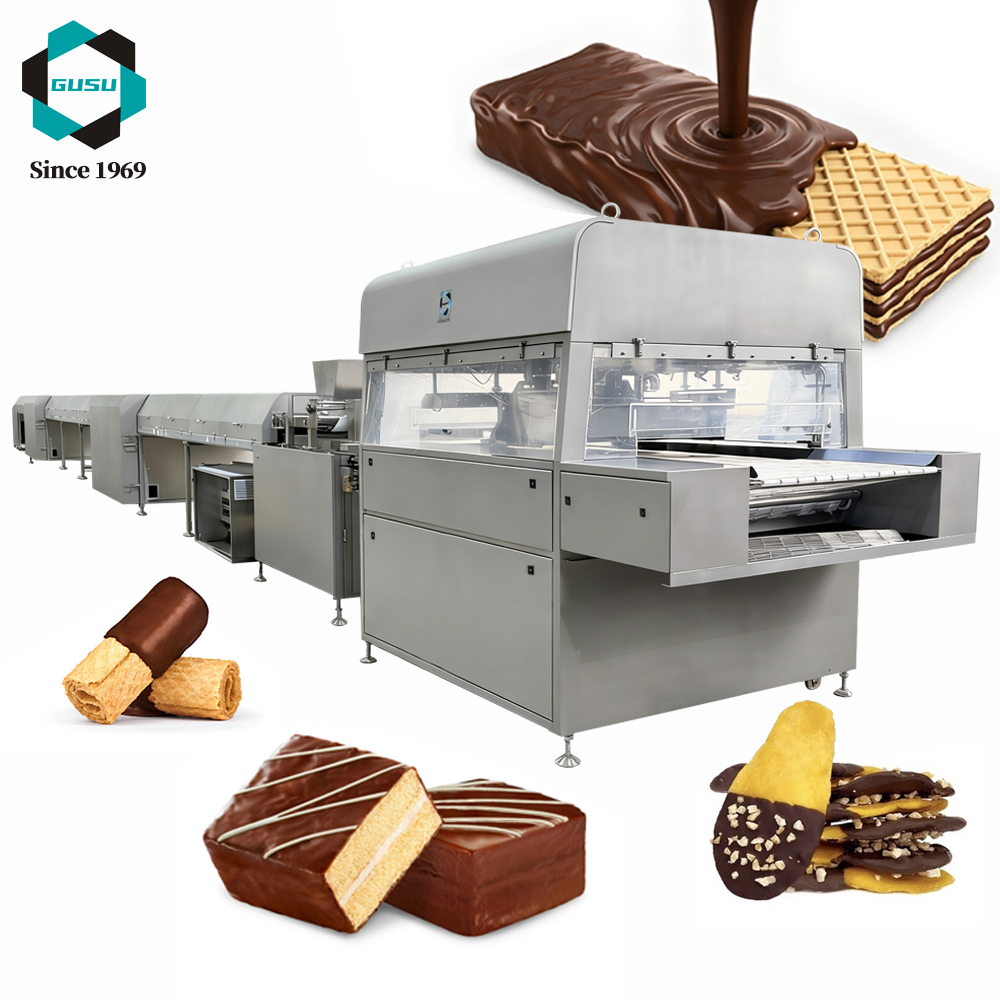
Working with single-origin couverture is less about finding one universal setting and more about reading the fat structure in front of you. Cocoa butter from Madagascar often sets firm and snappy at a slightly higher working temperature, while a Venezuelan couverture with a softer profile may need a longer hold at the bottom of the cooling curve to avoid dull streaks. Rather than relying on a preset programme, test a small batch and watch how the chocolate behaves at the edge of the bowl: if it thickens too quickly around the sides, the seed stage is probably too cold for that particular bean.
Nut pastes introduce a second set of variables that many chocolate tempering guides ignore. Hazelnut paste with a high natural oil content can thin the couverture and shift the crystallisation point, while almond paste that has been roasted longer tends to absorb more free fat and stiffen the mixture. The practical approach is to treat the paste as an ingredient with its own thermal inertia: warm it separately to just below the working temperature of the chocolate, then fold it in after the chocolate has passed the seed phase. This prevents the paste from shocking the cocoa butter into unstable crystal forms.
A useful habit is to keep a small tempering log for each origin and paste combination, noting the room temperature, the percentage of paste added, and the final cooling time before demoulding. Over a few batches, patterns emerge that are more reliable than any generic curve. For example, a high-acid couverture from Tanzania may need a shorter agitation window when paired with pistachio paste, while the same chocolate without any addition can tolerate a slower, more relaxed temper. These small adjustments are what separate a stable, glossy finish from a bar that blooms a week later.
Tool-Free Belt Removal That Makes Allergen Changeovers Feel Routine
Unsnapping a conveyor belt usually means reaching for pry bars, hex keys, or a maintenance cart nobody has time to find. Not here. The frame uses spring-loaded tensioners and lift-off end caps, so you pop the belt free with two thumbs and a slight downward tug. No bolts to drop, no torque specs to second-guess, and no hydraulic assist that needs its own cleaning log.
For allergen changeovers, that changes the rhythm of the room. Instead of treating belt removal as a fifteen-minute chore, teams do it between batches without breaking stride. The belt slides off, gets wheeled to the wash station, and a verified clean belt slides back on before the next flavor even reaches the hopper. Cross-contact checks stop being a bottleneck because the mechanical work no longer invites shortcuts.
What makes it feel routine is the lack of hidden steps. The end caps are color-coded by side, the tension release has an audible click, and every contact surface is smooth enough to wipe down with a single pass. You spend the changeover confirming cleanliness, not fighting hardware.
Closed-Loop Viscosity Control for Even Coating Thickness and Gloss
Viscosity drift during a coating run rarely announces itself. It shows up later as a wedge-shaped thickness profile or a dull patch that no amount of line speed adjustment can hide. Closing the loop means pulling real-time rheology data from an in-line viscometer and feeding it directly to a solvent or hardener metering valve, so the fluid arriving at the coater head stays within a narrow band instead of drifting with temperature, evaporation, or batch age.
The payoff is most visible where coating weight and gloss are measured together. When the controller trims viscosity every few seconds rather than after an offline cup reading, transverse thickness variation tightens and the surface levels out before the curing zone freezes it. This keeps gloss more uniform because micro-waviness and orange peel are often viscosity problems, not just applicator settings.
A practical setup treats viscosity as a cascade loop around the main coat-weight controller. The outer loop adjusts pump speed or gap, while the inner loop holds viscosity by dosing diluent or adjusting temperature. Alarms trigger on valve saturation or sensor fouling, because a loop that fights a clogged capillary is no longer controlling anything. The result is fewer rejected rolls, less manual sampling, and a finish that looks the same at the start and end of the shift.
Retrofitting Cooling Tunnels to Lock In Dark Chocolate Snap and Shine
Retrofitting an existing cooling tunnel rarely means ripping out the whole line. More often it comes down to rebalancing the air handling and adding zone controls so the chocolate leaves the tunnel with a clean contraction, a glossy face, and that sharp snap when broken. Older tunnels tend to push the same cold air at the same speed from entry to exit, which can shock the cocoa butter into unstable crystals or trap latent heat in the bar centres. Splitting the tunnel into staged temperature bands, adjusting damper positions, and adding low-velocity airflow at the first section lets the chocolate set from the outside in at a more predictable rate.
The retrofit work that matters most is usually hidden: recalibrating the dew point, fine-tuning exhaust volume, and making sure the belt surface does not pull heat away too quickly. Dark chocolate is less forgiving than milk because the higher cocoa butter content shrinks more as it crystallises. If the tunnel is too cold at the wrong moment, the surface can dull or develop faint white streaks. If it is too warm in the middle, the bar may release from the mould with a soft edge or a dull tap instead of a clean snap. Small additions like variable-frequency drives on the fans and better sealing around the tunnel mouth often have a noticeable effect on gloss, especially on high-cocoa recipes.
Many plants treat the cooling tunnel as a fixed constraint rather than something that can be tuned recipe by recipe. But a retrofit makes sense when the goal is to lock in the specific crystal structure that gives dark chocolate its hard fracture and mirror finish. By controlling the temperature drop in stages and keeping humid air away from the setting surface, the tunnel can do more than just remove heat. It becomes part of the tempering process itself, preserving the surface sheen and that brittle, clean break that people expect from a serious dark bar.
Designing Washdown-Ready Frames for Sticky Caramel and Nougat Runs
Caramel and nougat do not rinse away; they cool, set, and weld themselves to whatever they touch. A washdown-ready frame starts by treating every horizontal tube as a collection point. Round or solid-rod members should be used instead of open channel or angle stock, and any unavoidable horizontal span needs enough slope to shed water before it dries. Even a slight upward-facing ledge will hold a sugar film that hardens after the line stops.
Welds deserve more attention than the tubing itself. Ground-smooth, continuously welded seams leave no capillary gaps for syrup to enter, while passivated stainless resists the mild acids often used in cleaning. Exposed threads on feet, clamps, and sensor mounts are a common failure point; specify sanitary feet with captured seals and keep leveling threads covered or positioned outside the direct wash path. For bearings and pivot points, sealed or purgeable housings keep water out without trapping product inside.
Drainage matters as much as spray coverage. Base plates and closed box sections can trap rinse water under the frame, so open structures with minimal flat bottoms let water fall through to the floor trough. Conduit and cable runs should follow a downward path, avoiding drip loops that hold sticky liquid. When casters are unavoidable, choose sealed, brake-equipped wheels rated for hot washdowns, or mount them on quick-release plates so the frame can rest on fixed sanitary pads during production.
FAQ
They typically rework the tempering curve, lower the deposition temperature slightly, and adjust the cooling tunnel zones so the extra cocoa butter crystallizes evenly instead of leaving streaks or dull patches.
The service crew checks dew point and air movement near the enrobing belt, then suggests baffle changes and faster transfer into cooling to stop sugar bloom from forming on wet centers.
Yes, by tuning curtain thickness, blower speed, and residence time in the cooling tunnel, the same chocolate can set with a cleaner snap and better contraction from the belt.
Regular removal of chocolate fines, realignment of the licking rollers, and checking scraper tension keep the belt clean enough that feet and tails stop forming on finished pieces.
Look for practical deliverables like recipe trials, seasonal changeover support, and sensor calibration rather than vague inspection reports; those save more labor than they cost.
Real chocolate tolerates a much narrower working range, so the team retrains staff on viscosity control, pump speed, and clean-out procedures that prevent blockages and over-tempering.
Operators should run test batches with different center temperatures, learn to read the gloss of the curtain, and practice shutdown cleaning that protects the belt and rollers from damage.
They check whether the detailing rod is set too high, whether the blower is angled too steeply, and whether vibration after enrobing is knocking coating away from the base before it sets.
Conclusion
Production lines get noticeably calmer when fragile centers stop snapping at full speed. The enrobing setup is tuned so wafer and meringue pieces hold together through the entire run, with gentle transfers and targeted cooling that prevent the small breakages most lines accept as normal. Tempering profiles are matched to the specific behavior of single-origin couverture and nut pastes rather than forced through one default curve, so the chocolate flows well without losing its intended flavor or finish. Closed-loop viscosity control then holds coating thickness steady, which gives bars and pieces an even gloss and reduces the need for constant manual adjustment. The result is fewer rejected trays and less time spent reworking coated centers.
Allergen changeovers become less disruptive because the belt can be removed without tools, and the frame is laid out so cleaning crews can reach the areas that actually collect residue. For dark chocolate, cooling tunnels are retrofitted to lock in snap and surface shine rather than just hardening the outside before packaging. Washdown-ready construction proves its worth on sticky caramel and nougat runs, where sugar-heavy buildup can otherwise slow the next production cycle and drag quality down. That kind of practical design keeps the line moving without turning sanitation into a half-shift project.
Contact Us
Contact Person: Zhang Wei
Email: [email protected]
Tel/WhatsApp: 8618662577837
Website: https://www.chocomachinery.com