
OEM Swiss Type Lathe: Mastering Precision Turning for Complex Parts
2026-07-31
Precision turning for complex parts often feels like threading a needle in the dark—until you’ve mastered the Swiss-type lathe. For OEM manufacturers, tiny tolerances and intricate geometries aren’t just specs; they’re daily battles. That’s where WINNRUI CNC steps in, turning challenges into a competitive edge. In this post, we’ll unpack how the right Swiss-type technology redefines what’s possible, and why skipping on expertise could cost you more than you think.
The Heart of Swiss Precision: How Sliding Headstock Redefines Accuracy
The sliding headstock isn't just another mechanical feature—it's the quiet force that turned Swiss lathes into icons of precision. Unlike fixed-head designs, this moving spindle lets the bar stock pass through while the tool remains steady, almost eliminating deflection on long, slender parts. That means you can hold tolerances that would make conventional setups blush, all while the machine hums along with a sort of mechanical grace that’s hard to describe until you see it in person.
What really sets it apart is how it rethinks the entire cutting dynamic. Instead of the tool chasing the material, the material glides toward the tool in controlled, incremental bursts. Every pass happens right next to the guide bushing, so chatter and vibration get suppressed before they even start. The result is a surface finish and dimensional consistency that feel borderline obsessive—exactly the kind of thing you need when you’re making bone screws or micro-connectors that can’t afford a single slip.
Over time, this approach has quietly reshaped what “accurate” even means on the shop floor. It’s not just about hitting a number on a spec sheet; it’s about doing it over thousands of cycles without babysitting the machine. The sliding headstock turns complex, multi-step operations into fluid, single-setup routines—no re-chucking, no stack-up errors, no midnight phone calls about parts gone wrong. That’s the kind of shift that doesn’t just improve accuracy. It changes the whole conversation around it.
Conquering Complexity: Turning Intricate Geometries with Ease
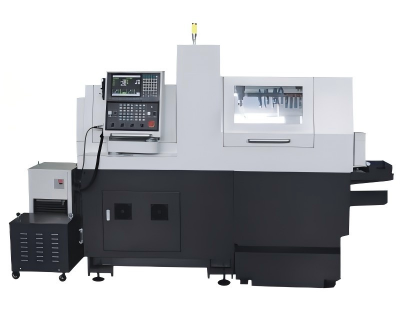
Tackling parts with tight tolerances and unconventional contours used to demand painstaking manual setups and constant operator intervention. Modern turning centers now fuse adaptive control systems with real-time tool monitoring, allowing the machine to adjust feed rates and cutting paths on the fly. This means that even when you’re dealing with deep cavities, thin walls, or abrupt diameter changes, the process remains stable and predictable.
The real breakthrough lies in how advanced software interprets the digital model. Rather than relying on generic toolpaths, CAM systems now generate dynamic trajectories that anticipate material behavior, minimizing chatter and deflection. Pair this with high-rigidity spindles and vibration-dampening tooling, and you get finishes so smooth that secondary operations often become unnecessary. It’s not just about speed—it’s about achieving surface integrity on complex profiles without the usual trial and error.
What makes all this accessible is the shift toward intuitive programming interfaces. Operators no longer need to be code wizards; conversational controls and graphical simulations let you visualize the entire turning sequence before a single chip is made. This demystifies the process, so even challenging asymmetric components or multi-feature parts can be produced with confidence, collapsing the gap between design ambition and shop-floor reality.
OEM Excellence: Tailoring Solutions for High-Mix, Low-Volume Production
When production volumes shrink and variety surges, traditional manufacturing approaches often buckle under the strain. Our OEM model is built from the ground up to handle this complexity. Instead of forcing your products into rigid, high-volume lines, we design flexible cells that can pivot between different product configurations with minimal downtime. This isn't about simply managing small batches—it's about making each one as efficient and cost-effective as a full production run.
The key lies in adaptive supply chain orchestration and cross-trained teams that understand the nuances of your varied portfolio. We invest in rapid-changeover tooling and digital work instructions that guide operators through each build, ensuring consistency no matter how often the specifications shift. Every product, from prototypes to niche derivatives, receives the same engineering rigor and quality oversight, without the overhead that usually plagues low-volume work.
Ultimately, this approach turns high-mix, low-volume production from a headache into a strategic asset. You gain the freedom to innovate, customize, and respond to market shifts without being penalized by cost or lead time. By treating variability as the norm rather than an exception, we help you deliver exactly what your customers need, when they need it—without compromise.
Beyond Standard Turning: Multi-Axis Capabilities in Modern Swiss Lathes
Simultaneous five-axis interpolation enables intricate part features to emerge without repositioning. Faces, angles, and deep pockets are milled while the main spindle holds the bar stock, blending turning with prismatic machining in a fluid sequence.
A second spindle with full Y-axis travel transforms back-working operations. Thread whirling, eccentric drilling, and cross-milling happen in synchronization with front-end turning, so a component leaves the machine fully finished—no secondary fixtures required.
Thanks to orchestrated motion across multiple tool carriers, slender medical screws, bone plates, and micro-mechanical housings now ship with tolerances measured in microns. The ability to contour simultaneously with turning redefines what belongs on a Swiss lathe instead of a dedicated mill-turn center.
Material Matters: Machining Tough Alloys to Tight Tolerances
Selecting the right material is only half the battle—how it behaves under the cutting tool defines everything. Tough alloys like Inconel, titanium, and hardened tool steels resist deformation, which is exactly why they’re chosen for aerospace and medical components. But that same strength translates into punishing machining conditions: high cutting forces, rapid tool wear, and a constant risk of work hardening. Without a deep understanding of each alloy’s grain structure, thermal conductivity, and spring-back tendency, holding a tolerance of ±0.0002 inches can feel more like gambling than manufacturing.
Experience teaches you that these materials don’t just cut differently; they demand a different rhythm. Spindle speeds drop, feed rates get adjusted, and coolant becomes a precision tool rather than just a flood. For nickel-based alloys, the heat has to go into the chip, not the part or the cutter. That means aggressive peck cycles, short engagement times, and often a switch to ceramic or diamond-coated inserts. Even the smallest oversight—a dull edge, a misaligned fixture—can cause the material to push back, distort, or grab the tool. The margin for error shrinks to microns.
Achieving tight tolerances consistently requires more than just a rigid machine; it demands a process built around the material’s personality. Stabilizing the workpiece through stress-relieving pre-cuts, measuring thermal expansion in real time, and finishing with light, controlled passes—these aren’t optional extras, they’re the baseline. When the alloy fights you, every detail matters. The payoff, though, is a part that slips into its assembly with a whisper of clearance, made from a metal that will outlast the machine that shaped it.
From Prototype to Production: Scaling Precision Without Compromise
Moving from a hand-built prototype to full-scale manufacturing is where the real test begins. Early models often perform perfectly under controlled conditions, but replicating that performance across thousands of units introduces variables that can quietly erode precision. Material batches shift, tooling wears, and assembly processes that worked for ten units can introduce subtle deviations when scaled to ten thousand. Without a deliberate strategy to lock in tolerances, what starts as a promising prototype can quickly become an inconsistent product.
True scaling isn't just about increasing volume—it's about building a system where every component, process, and inspection step works together to maintain the original design intent. This often means embedding real-time quality checks directly into the line, using automated measurement tools that catch drift before it becomes costly. It also involves designing for manufacturability from the start, so that tight tolerances are achievable not just in the lab but on a busy factory floor with minimal manual adjustment.
The teams that navigate this transition successfully treat scaling as a discipline, not an afterthought. They invest in process capability studies, statistical control, and feedback loops that connect what's happening in production directly to engineering. The result isn't just a product that matches the prototype—it's one that performs reliably, unit after unit, without the need for constant rework or compromise.
FAQ
Their sliding headstock and guide bushing support the workpiece close to the cutting tool, minimizing deflection and enabling precise machining of long, slender, or intricate components.
Through thermally stabilized structures, high-precision linear guides, and real-time tool offset compensation, OEM Swiss machines consistently hold tolerances within a few microns.
Yes, modern Swiss-type lathes integrate live tooling, back working, and multi-axis capabilities, allowing complete machining of complex parts in a single setup without manual intervention.
From stainless steel and titanium to brass, aluminum, and engineering plastics—Swiss lathes excel with a wide range of materials, often using high-pressure coolant for chip control.
By leveraging synchronized subspindle operations, high-speed tool changes, and optimized bar feeder integration, OEM Swiss lathes significantly reduce idle times while maintaining precision.
OEM manufacturers offer proven kinematics, long-term service support, and access to advanced software for complex geometry programming, ensuring reliability and higher uptime.
Advanced CAM systems tailored for Swiss machining simplify programming of overlapping operations, simulate material removal, and help avoid collisions, reducing setup time and scrap.
Conclusion
OEM Swiss type lathes are engineered to achieve unprecedented precision in complex part manufacturing, driven by their signature sliding headstock design. This architecture eliminates common deflection issues by feeding the bar stock through a guide bushing, keeping the cutting tool extremely close to the support point. The result is remarkable accuracy even on slender, intricate components. When paired with advanced CNC controls, these machines conquer complex geometries—from tiny medical screws to delicate watch parts—with ease, routinely holding tolerances in the micron range. OEM customization further elevates their value: manufacturers can tailor tooling layouts, spindle configurations, and automation options to suit high-mix, low-volume production environments, drastically reducing changeover times and optimizing workflow for specialized parts.
Beyond basic turning, modern Swiss lathes integrate multi-axis capabilities, including live tooling, sub-spindles, and Y-axis movement, enabling milling, drilling, and cross-machining in a single setup. This eliminates secondary operations and cumulative errors, ensuring consistent quality from the first prototype to full-scale production. Material versatility is another cornerstone—these machines adeptly process tough alloys such as titanium, Inconel, and hardened steels, maintaining tight tolerances and superior surface finishes. Whether machining a critical aerospace component or a high-volume medical implant, the combination of thermal stability, high-pressure coolant systems, and real-time process monitoring guarantees that precision is never compromised as production scales. Ultimately, OEM Swiss lathes deliver a turnkey solution for turning complex parts with unyielding accuracy.
Contact Us
Contact Person: Tim
Email: [email protected]
Tel/WhatsApp: +86 15522553731
Website: https://www.winnrui-cnc.com/