

Plastic Push Pull Connector Manufacturer Evaluation Checklist and Best Practices
2026-11-18
Sourcing plastic push-pull connectors can feel straightforward—until a batch fails in the field or a supplier’s tolerances drift. A clear evaluation checklist changes that. This guide breaks down the criteria that actually matter, from material consistency and contact retention to documentation and long-term support, so your qualification process is less guesswork and more repeatable. Along the way, we include practices drawn from REUNION’s manufacturing and quality assurance experience to help you spot the difference between a vendor that merely quotes specs and one that builds to them.
Plastic Resin Choices That Predict Connector Durability
Durability in connectors rarely comes down to a single spec sheet value. It is more often shaped by how a resin handles moisture, thermal cycling, and sustained insertion forces at the same time. A glass-filled PBT can look strong on paper, but in a humid engine compartment it may slowly hydrolyze, lose tensile strength near molded-in stress points, and eventually develop microcracks around the terminal retention features. Nylon brings good toughness, yet its tendency to absorb moisture can swell the housing enough to change insertion force or allow terminal fretting over thousands of thermal cycles.
High-temperature resins such as LCP and PPS do not automatically solve these problems. LCP offers very low moisture uptake and excellent flow in thin-wall sections, but its weak weld lines and limited elongation can turn a minor assembly stress into a split boss or latch. PPS handles prolonged heat well, though brittleness makes it unforgiving in thin snap-fits and tight corners. The practical choice usually depends on which failure mode the design can tolerate: dimensional drift from moisture, loss of normal force from creep, or mechanical fracture during mating and unmating.
Predicting durability therefore means mapping resin behavior to the connector’s actual load path. Stress relaxation in the plastic directly affects contact normal force, while CTE mismatch between the housing and the pin can accelerate plating wear on the contact interface. Additives such as flame retardants and lubricants further influence ion migration and contact resistance stability. When these resin-related effects are considered together, material selection becomes less about choosing a familiar grade and more about matching the polymer’s long-term failure signature to the connector’s expected service life.
Mold Consistency Checks for Push Pull Connector Housings
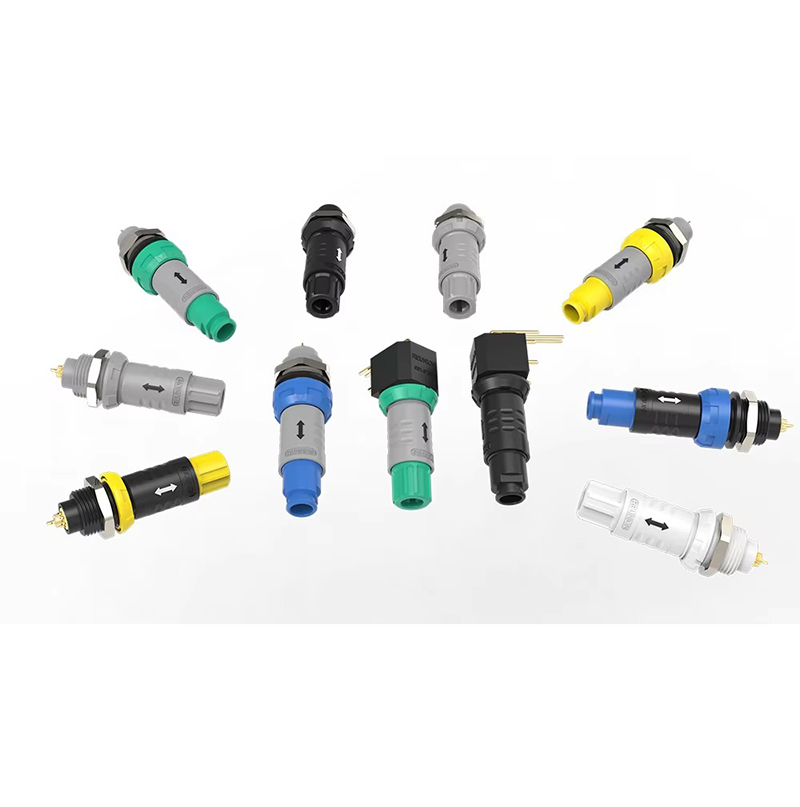
Mold consistency checks on these housings tend to start at the latch window and the split line. A housing with an integrated latch or an outer shell has to hold the latch engagement depth within a narrow band, often around 0.05 mm, and that dimension shifts quickly if a core pin moves or if packing pressure drifts. Rather than measuring every cavity feature, the line usually relies on a go/no-go fixture with a reference plug and a spring-loaded latch catch. If the catch does not click with the same force shot after shot, the tool is pulled for a deeper dimensional audit.
Cavity balance is another place where inconsistency shows up early. In a 2+2 or 4+4 tool, slight differences in fill speed and packing between circuits rarely appear on the main outer body, but they do show up at the rear wall where the cable exit opening meets the parting line. That is where flash, sink, or a slightly oval bore appears. A practical check is to take the last five shots from each cavity, measure the cable entry bore at three clock positions, and compare the spread across cavities. The tool is considered consistent when the spread stays tight, even if the nominal diameter is close to the upper or lower limit.
Material behavior can also make a dimensionally stable mold look inconsistent. Glass-filled PBT or nylon can separate during a long run, and the weld line near the latch root may move slightly. When that happens, the housing often still meets drawing dimensions but fails a latch cycling test because the snap-fit force drifts. A short-run audit might include an ash content check and a bench flex test on the latch, not just a visual check for flash. If the flex force changes while the steel dimensions remain stable, the problem is usually temperature balance or material feed, and that is corrected before the mold itself is reworked.
Cycle Testing Beyond Data Sheet Ratings for Plastic Connectors
Most data sheets stop at a comfortable number—500 cycles, maybe 1,000 if the vendor feels generous. Those figures come from clean benches, room-temperature air, and freshly molded housings. Pull a plastic connector out of the box, mate it a few hundred times in a dusty enclosure with a slight side load, and the story changes fast. Cycle testing beyond the rated values is not about proving the part fails at 1,001 insertions; it is about finding where the latch tang starts to micro-crack, where the polarization rib shaves off enough material to allow misalignment, and how much contact normal force survives after the housing has lost its original stiffness.
Wear on a plastic connector rarely announces itself with a clean snap. You notice it first as a change in insertion feel—softer, less positive, maybe a faint gritty drag from accumulated polymer dust inside the socket. By the time an operator complains, the connector may still pass a continuity test, but the retention force has already dropped below what the original design margin allowed. Extended cycling exposes secondary effects: creep in the plastic spring beams, abrasive smoothing of the locking surfaces, and moisture uptake that accelerates surface fatigue. A connector rated for 500 cycles might survive 3,000 in a controlled lab, yet die at 700 when cycled with a modest cable hang angle because the wiping motion grinds the contact tips against the housing wall.
The practical takeaway is to test the assembled system, not the bare component. Mount the connector as it sits in the field—cable attached, strain relief engaged, mating axis slightly off-perpendicular. Track insertion and extraction force on every tenth cycle, and measure contact resistance under low-level dry-circuit conditions rather than at high current, since plastic debris can create intermittent opens that heavier loads mask. Look at the wear debris under a microscope: fine powder suggests abrasive wear, while small flakes indicate surface fatigue spalling. If the housing shows stress whitening near the latch before the rated cycle count even ends, the datasheet number was never the limit—your assembly method was.
Lead Time Claims Worth Verifying Before You Commit
Most lead time claims sound reassuring until you realize they were measured from the moment the order hits the factory floor, not the day you actually hit checkout. That gap between a polished promise and a packed warehouse is where surprises live. Before you build a launch calendar or promise delivery dates to your own customers, ask what the quoted window includes. Does it cover material sourcing, quality checks, packaging, or just the final assembly sprint? A supplier who says “seven days” without blinking often means seven days after every component magically appears.
It also helps to press for consistency rather than a single impressive number. A vendor might show you a screenshot of one fast order, but you need to know what happens when they’re juggling forty others. Request data on average turnaround over the past three months, including delays caused by customs hiccups or machine downtime. If they hesitate to share anything beyond a smiling sales chart, treat that lead time as a marketing line, not a logistics fact.
Finally, verify the small print around reorders. Many companies tighten their first-order timeline to win your business, then quietly extend it once you’re dependent on their stock. Ask directly how lead times shift when you reorder the same SKU, and whether rush options actually cost less than losing a week of sales. A trustworthy partner will give you a range, explain the variables, and admit when weather or holiday backlogs push things sideways. Anything less deserves a second look before you sign.
Customization Requests That Reveal Real Engineering Depth
When a client asks for a small change that seems almost trivial—a slightly wider mounting flange, a different thread pitch on a single port, or a control loop tuned for a pressure curve nobody has charted yet—the request often separates engineers who configure from engineers who understand. The surface-level ask is rarely the actual problem. Behind it sits a chain of assumptions about thermal expansion, assembly sequence, material fatigue, and how the component behaves when the line runs hot for nineteen hours on a Thursday night. Engineers who have spent real time on the floor recognize that the simple tweak ripples through tolerances, fasteners, seals, and service procedures. That recognition is the first sign of depth.
Real depth shows up in the questions that follow the request. Instead of saying yes or no, a capable engineer asks what changed upstream, whether the current design is failing or just inconvenient, and who actually touches the part during installation and maintenance. These questions can feel like friction to someone who just wants a quote, but they prevent a customization from becoming an expensive workaround layered on top of an unexamined constraint. The goal is not to impress the customer with complexity. It is to find the smallest change that respects the physical system and the people who have to live with it.
The most telling customizations are the ones that force a choice between two valid but incompatible priorities. A lighter frame may be easier to maneuver but will shift its natural frequency closer to a motor’s operating range. A more aggressive seal material may handle a wider chemical range but increase breakaway torque enough to frustrate a handheld tool user. Working through that tension requires not just design knowledge but a mental library of past failures, field notes, and supplier quirks. When the answer ends with a clear recommendation and a candid note about the trade-off, the customization reveals more than competence. It reveals judgment.
Quality Documentation and Traceability for Plastic Connectors
For plastic connectors, the paper trail often matters as much as the part itself. Each batch is linked to raw material lot numbers, molding parameters, and cavity-specific inspection records, so a single finished connector can be traced back through every stage of production without guesswork.
Documentation is structured around what the downstream assembler actually needs: dimensional reports, material certifications, and process deviation logs travel with the shipment rather than sitting in a separate archive. That way, if a fitment issue appears weeks later, the relevant data can be pulled in minutes instead of days.
Traceability also extends to tooling history and engineering changes. Revision-controlled drawings, insert wear logs, and first-article packages are kept together so that a change in cavity pressure or a switch in polymer supplier is visible against the connectors produced before and after the event.
FAQ
Start by pulling together the mechanical, environmental, and electrical requirements your device actually faces. Then compare those against the manufacturer's stated ratings for mating cycles, temperature range, ingress protection, and contact resistance. A supplier that asks detailed questions about your application early usually saves more trouble later than one that only sends a catalog.
Look beyond the basic 'plastic' label. The housing resin, seal material, and contact plating each need to be matched to the exposure conditions. For example, a polycarbonate housing might be fine in a lab but can struggle with certain cleaning agents, while PEEK or polysulfone may hold up better where chemical or sterilization demands are higher. Ask for chemical compatibility data rather than relying on generic chemical resistance claims.
Request the test method behind the number. A credible supplier can usually describe the mating speed, alignment tolerance, and pass/fail criteria used during endurance testing. If the only answer is a number on a datasheet, treat it as a starting point and ask for a sample set to validate in your own housing or panel setup.
Watch for unexplained batch-level variation in color, flash around molded parts, or inconsistent marking. Also pay attention to how they handle nonconforming material and whether traceability extends to resin lots and plating baths. A clean final assembly area matters, but the bigger risk is often in incoming material control and change notification discipline.
Focus on certifications that align with the intended market and risk level. ISO 13485 matters for medical devices, while IEC or UL component recognition may be more relevant for industrial or lab equipment. Ask to see the actual certificate scope and expiry date instead of just confirming that the company is 'certified'.
Build a short stress test that reflects your real use: repeated connect/disconnect at your expected angle, cable flex near the strain relief, exposure to your cleaning or sterilization process, and a thermal shock cycle if the device moves between environments. Measure contact resistance before and after, because visible damage can lag behind electrical degradation.
They matter mainly as risk factors, not just convenience. A shorter lead time means less exposure to forecast errors, but it only helps if the manufacturer can maintain that lead time when demand shifts. Local application support can speed up solving fit or assembly issues, especially if your team cannot easily travel to the factory.
Conclusion
When you start comparing plastic push pull connector suppliers, the resin conversation usually tells you more than the marketing claims. Ask why a manufacturer picks glass-filled nylon over PEEK or polysulfone for a given housing, especially when latching arms have to survive repeated flexing and exposure to cleaning agents. The answer should include practical trade-offs around impact strength, chemical resistance, and temperature behavior, not just a generic statement about high performance. Mold consistency comes next: checking for shrink marks, gate placement, and dimensional drift across multiple lots can reveal whether the tooling is well maintained or simply running until it fails. Likewise, cycle testing should go beyond the printed data sheet numbers. Request results from tests that include side load, rough handling, and thermal swings, since those conditions more closely match field use.
Lead time claims deserve the same skepticism. Instead of accepting a quoted eight or ten weeks, ask what actually consumes that time, including mold changes, sampling, and first article approval. A supplier that can break down the schedule and point to past projects is far more reliable than one that just repeats a standard date. Customization requests are also useful for judging engineering depth: a factory that suggests rib adjustments, alternative resins, or improved sealing details during the quoting stage has people who understand how the connector behaves in use. Traceability is the last piece, and it should cover resin batch records, processing parameters, inspection data, and change notifications. If those documents are hard to get before an order is placed, they will not get easier when quality problems arise.
Contact Us
Contact Person: Hayley Liang
Email: [email protected]
Tel/WhatsApp: +86 13480625451
Website: https://www.reunion-china.com/